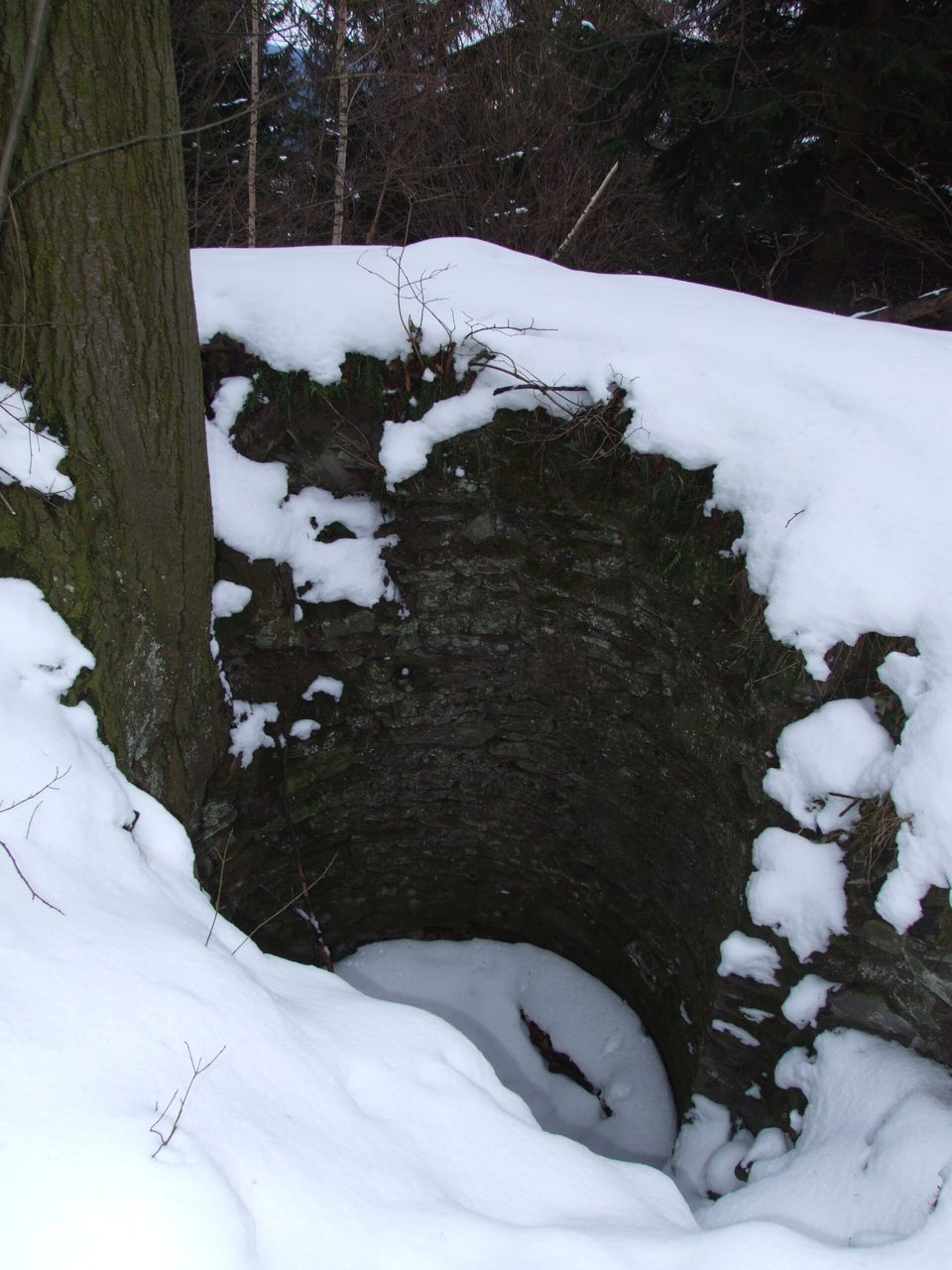
The castle originated at the end of the thirteenth century, probably at the instigation of the Opava Duke or the Wrocław Bishop Thomas the Second, and this after the nearby Edelštejn Castle lost its significance. Leuchtenštejn was supposed to guard the surrounding mines and perhaps also served as a temporary storage for extracted precious metals and ore. It reached its peak in the first half of the fourteenth century, when a lively existence prevailed here, but it probably fell victim to the Hussite Wars, as archaeological findings of destruction suggest. Earthwork ramparts with a stone facing, moats, tower foundations, and remnants of a multi-part palace and utility buildings in the courtyard have been preserved, along with traces of two entrance gates. The massive tower, with a diameter of about eight meters and a height of twenty to twenty-five meters, was apparently blown up with gunpowder or collapsed on its own; today, only scattered blocks remain of it. Furthermore, during archaeological research, remnants of gilded forged armor from the fourteenth century were found, which proves how wealthy the lords who once resided here were.
Audio guide · Olomouc Region
Leuchtenštejn
The ruins of a guard castle from the end of the thirteenth century in the Jeseníky Mountains above Zlaté Hory, associated with ore mining.
Reads the text aloud in English, right in your browser.
The full guide in the Loquari app
In the app you can listen to this place in 16 languages, with a map and navigation – and offline once downloaded.
Where it is
Olomouc Region, Czechia
GPS 50.26220 N, 17.42110 E